Showing posts with label week 10. Show all posts

Wednesday, October 26, 2016

Storytelling: A Game of Cat and Mouse

Once there lived a cat named Tom and a mouse named Jerry. All the other mice would talk about how intimidating Tom was and whenever he was in the house, all the other mice would run into their hole and stay there until he went back upstairs with his owner. Jerry, however, was never intimidated by Tom and made sure all the other mice knew that he was not scared of some big furry bully.

As it got colder, Tom began to hang out more downstairs by the fire in the living room with his owner. The mice knew this meant they would have to spend more time tucked away in their holes. Jerry refused to stay hidden for almost all of winter and came up with a plan.

"I'm doing to show that nasty old Tom that he isn't the boss of me!" Jerry exclaimed to the rest of the mice.

They all shook their littles heads in dismay, fairly sure that Tom would eat Jerry if he had the chance. Jerry began plotting how he was going to outsmart Tom and make it safe for him and the other mice to roam freely during the winter. Suddenly, he had an idea.

He went up to the attic and searched for a few hours until he found enough metal and rope. After gathering all the materials he needed he ventured back downstairs to his hole to start working on his contraption. On his way, he crossed paths with Tom. As Tom approached him, he chuckled under his breath.

"And just what do you plan to do with all that junk, little mouse?" Tom questioned

"Oh, you'll see, Tom. You think you're so wise and can intimidate all the other mice into hiding. But not me!" Jerry replied.

With one last laugh, Tom pranced off upstairs without another thought or care as to what Jerry was up to. Jerry knew he had the upper hand now that Tom did not see him as a threat. He set to work building the contraption that Tom would not see coming: a bear trap.

A few days later, Tom was curled up near the fire sleeping. Jerry decided this was the perfect time and set the bear trap right outside his hole. He made his way near the fire and within seconds, Tom could smell him.

"Oh how nice," Tom said. "My dinner has delivered itself to me"

Just like that Jerry started to scurry back to his hole with Tom close on his tail. When he got close to the trap, he swerved around it to avoid getting stuck himself. Tom was too preoccupied with catching Jerry and did not notice the bear trap until it was to late. With a loud clamp, the trap shut around Tom's paw and he yelped in pain. Jerry was safe in his house and Tom had no way to reach him. All the other mice peered their heads out of their hole to see what was the commotion and saw that Jerry had outsmarted Tom just as he had said he would. Tom learned to never mess with Jerry and the other mice again and mainly stayed upstairs in his owner's room where he was safe.
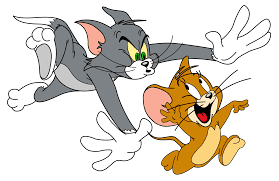
Tom and Jerry 


Author's Note:
I wanted to try a different story telling technique this week, so I chose to re-write Shin-ge-bis Fools the North Wind as a child's story. I've never used this style before so I decided to write is as a story from the hit cartoon Tom and Jerry. In the original story, Shin-ge-bis, also known as the diver, tells all the fishermen who are scared of Ka-bib-on-okk, the North Wind, that he is not scared of him. Shin-ge-bis tells all the fishermen that he will outsmart the North wind. None of the other patrons believed this and they all retreated just like the mice in my story doubted Jerry and stayed away in their holes. Shin-ge-bis ends up taunting Ka-bib-on-okka enough to where the North Wind enters Shin-ge-bis's home and ends up thawing and nearly melting away. I wrote in my story that Jerry taunted Tom enough that he lured him into the bear trap. In both cases, the antagonist go too sure of himself and his ego lead him right into the hands of the protagonist. I chose to re-write this story because I like the moral that the underdog or good guy can outsmart the bad guy even if nobody else believes that he can. This style of writing was interesting and a lot of fun to try out. I may try to use this style again late in another story I do.   


Bibliography:
American Indian Fairy Tales by W.T. Larned, with illustrations by John Rae (1921). Shin-ge-bis Fools the North Wind

Monday, October 24, 2016

Reading Notes: American Indian Fairy Tails Part B

I will be continuing with my reading of American Indian Fairy Tails.

One thing I found interesting in the story of The Boy Who Snared the Sun was that even when he did a few things on his own, he still resorted to asking his sister to do things for him instead of doing them for himself. She was the one who stitch the skins of the birds together to make him  coat after he had killed them all. If she had not done that for him, he would have dead birds but would have been cold. The sister had started out worried that when she left, her brother would not be able to defend or take care of himself. By the end, he was demanding her services and she was compliant! I did not like that she started out as a strong, independent female lead and once again fell into the role of the compliant, quiet female being ordered around by men. I'd like to retell this story with her give him hell and telling him to solve his problems on his own. That would have been a fun plot twist.

Something that is really interesting is that each animal is known for some specific trait whether it is the bear for his strength, the beaver for his laugh, or the coyote for his wit. It explains why we associate those stereotypes with each animal with a fun background story. Background stories are always something fun to play with because you can make up whatever reasoning you want to explain why things are the way they are.

I was shocked in the story "How the Summer Came" with how dedicated the father, O-jeeg, was willing to do whatever he could to make his son happy. This just exemplifies the way parents love their children and it really touched my heart. It would be fun to do a storytelling where the parent maybe goes out of their way or even puts themselves in danger to create a better life for his/her child. Something to consider for later on when I need ideas.

Storytelling from Native Americans


Bibliography:
American Indian Fairy Tales by W.T. Larned, with illustrations by John Rae (1921). 

Reading Notes: American Indian Fairy tails Part A

This week I chose to read American Indian Fairy Tails.

I like the cockiness of Shin-ge-bis and how confident he is that he can outsmart the North Wind. He is very clever and knowing how to fish in the winter and being bundled up but I had a feeling from the start that his confidence could be his downfall if he wasn't humble enough. This story had the moral that positive, happy energy can over come even the coldest and darkest of times (i.e., the North wind). This was a cute telling of it because it was not straight away obvious that the lesson would be about positivity winning out over darkness. It made an even great impact that the other fishermen left Shin-ge-bis because they did not believe they or even he could over come to North wind. It goes to show that even when others doubt themselves and you, there is still hope.

Iagoo is such an interesting character. He is old and wise and a story teller and would make for a fun narrator for one of my story telling assignments. One thing that had me curious though is why he seemed so spaced out before Morning Glory came over to snap him out of it so he would tell the children a bed time story. It would have been interesting to hear what his thoughts were at that moment; if they were something deep or if he was pondering what story he wanted to share with the children next.

Honestly, one of the reasons I chose this section to read for the week was because in my portfolio review group from this past weekend I read a storytelling based on The Little Boy and Girl in the Clouds. The story peaked my interest enough that I decided to go through and read the original story for myself. I guess you could say that student did a top notch job of engaging the readers. I think it was funny how the Coyote won't answer the parents question of how their son and daughter got up on the rock since he doesn't know the answer. Very political, he changes the question to be more about how to get them down, which I can't argue is a very important question in their circumstance.

Native American Storytelling


Bibliography:
American Indian Fairy Tales by W.T. Larned, with illustrations by John Rae (1921).